
Cart
0
£0.00
Traditional systems seal the wall from the outside. Exoline changes the way the structure works from the inside. Exoline is an advanced, multi - component moisture protection system. It is not based on sealing the surface, but on changing the internal operation of the structure itself.

Exoline technology: why it is different, and why it works
Works inside the structure, not only on the surface.
Helps manage moisture, not just trap it inside.
Improves durability and long-term resistance.
About 15 years ago, it wasn't the development of yet another coating that began, but an entirely different way of thinking. The question wasn't how to seal the wall even more effectively from the outside, but how to manage the moisture problem within the structure itself.
The starting point was simple: moisture should not be trapped inside the wall; instead, the structure itself needs to be made capable of handling it in a controlled manner.
Exoline® is an advanced, multi-component moisture protection system. It is not based on sealing the surface, but on changing the internal operation of the structure itself.
Based on ExoBase™ technology, microscopic particles with an average size of 4 microns and a high specific surface area penetrate deep into the capillaries of concrete, plaster, and cement-based adhesive layers. There they fill the micro-gaps, densify the structure, and restrict the movement of liquid water.
However, the real essence of the technology is not simply water sealing.
Unlike conventional sealing systems, Exoline® does not suffocate the wall. While it significantly reduces the passage of liquid water, it does not block the escape of water vapor. The structure remains vapor-permeable, so moisture does not become trapped inside but can exit safely in vapor form.
This dual action - restricting the path of liquid water while preserving vapor permeability - is what gives Exoline® its true advantage.
The material does not act as a separate insulating layer that could eventually delaminate, degrade, or flake off over time. During the bonding process, it becomes an integral part of the structure. It does not work on the wall - it works within the wall. It does not merely cover up the problem; it intervenes exactly where moisture actually moves: in the capillaries, pores, and micro-gaps.
That is why Exoline® is not a simple waterproofing coating. It is a structural moisture management technology that can be used both in new construction and renovation projects - with simpler application, fewer layers, a more durable operating principle, and significantly lower long-term maintenance requirements.
Bituminous membranes, films, or conventional coatings always create an additional, separate layer. In contrast, Exoline® does not think in terms of a separate shell. Instead, its logic is that the structure itself becomes part of the solution.
One of the key advantages of Exoline® is that it reduces the movement of liquid water within the structure while keeping the wall fully vapor-permeable. This means moisture does not become trapped inside but can escape safely in vapor form.
This is also crucial from an energy perspective. A damp wall is colder, conducts heat away faster, and impairs the building's thermal performance. As a result, not only is more energy wasted, but the weak points present in every building are amplified: plinths, corners, floor slab junctions, basement walls, lintels, balcony slabs, foundations, and other thermal bridge elements.
When moisture is also present in these zones, the problem multiplies. The inner surface of the wall stays colder, condensation appears more easily, and mold follows. No matter how many new plasters, coatings, or even thermal insulation layers are applied, if moisture continues to work inside the structure, the energy performance cannot truly improve.
In contrast, a drier and more stable wall structure delivers better thermal performance: lower heat loss, reduced energy demand, warmer interior wall surfaces, and a healthier living environment.
Exoline® is built entirely on 100% natural raw materials - ingredients that can be found everywhere in the world. It is not an overly complicated or hard-to-reproduce technology, but a natural-based approach that works with the physical functioning of the structure itself.
Exoline® was not developed simply as a consumer product for households. Water, moisture, and structural damage are equally present in industrial facilities, public buildings, heritage sites, bridges, tunnels, waste management and energy environments, agricultural facilities, and state infrastructure.
Even in a residential house, it is a serious loss if the same fault has to be repaired every 2-3 years. But when it comes to a hospital, a heritage building, a bridge, a tunnel, or a large-scale agricultural facility, the cost of short-lived solutions is no longer just a simple annoyance - it means repeated renovation cycles, downtime, operational risks, and often additional costs measurable in millions.
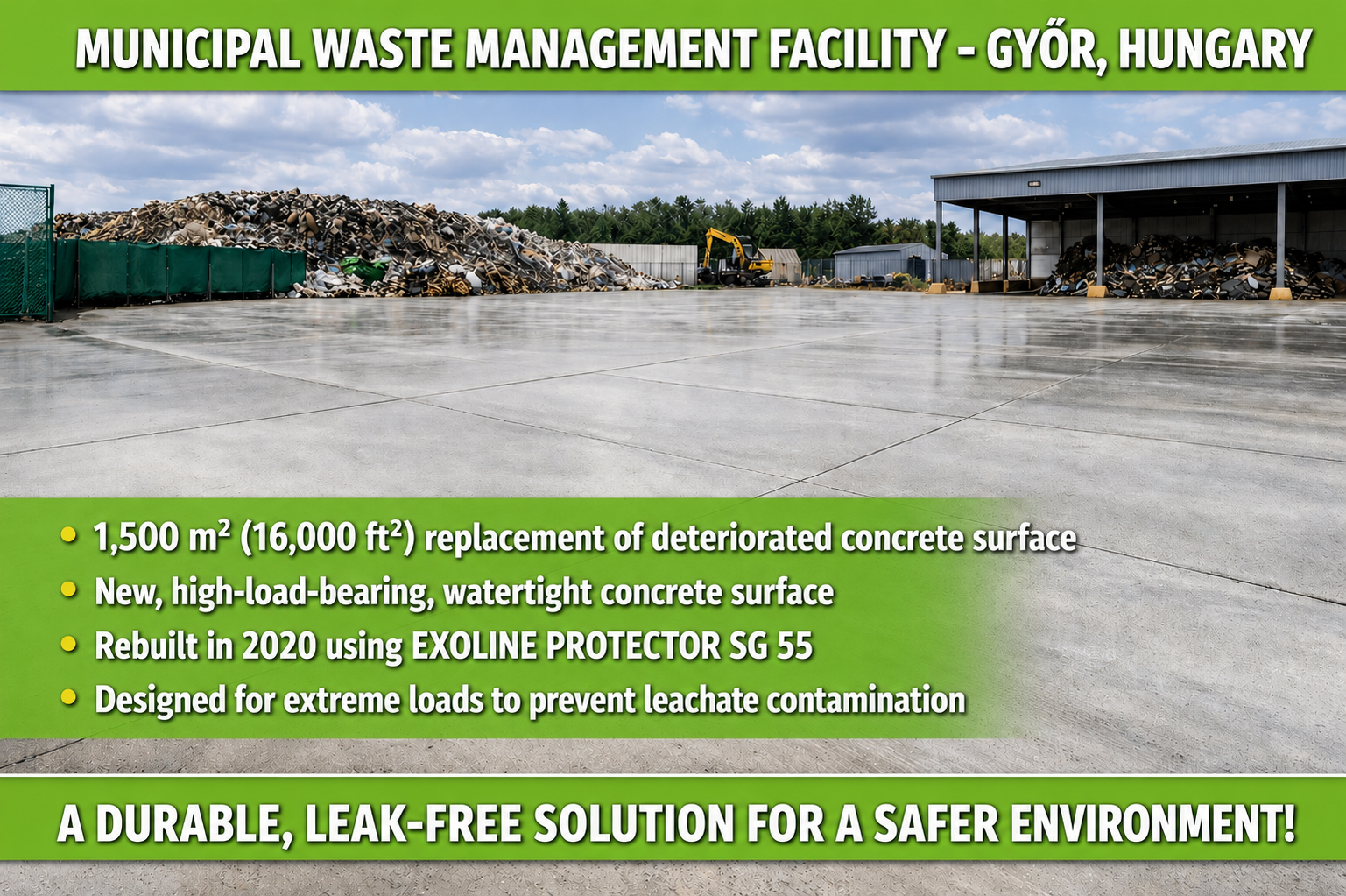
In 2020, at the Gyor Municipal Waste Treatment Plant, a complete concrete replacement was carried out over an area of 1,500 m². The original concrete surface had suffered significant damage due to continuous mechanical stress and chemical effects from the waste materials. The damaged concrete was removed in its entirety and replaced with a newly designed, high-load-bearing slab. The new structure was made using Exoline® PROTECTOR SG-55 concrete additive to ensure outstanding performance.
One of the project's main objectives was to achieve high load-bearing capacity suitable for intensive industrial use. An equally important requirement was full waterproofing. The upgraded concrete system was designed to prevent percolate from leaking into the soil or entering the water network. Since its handover, the surface has demonstrated excellent structural stability and durability even under extreme operating conditions. The facility has been operating continuously ever since, without any structural degradation or leakage problems.
During the renovation of the Komarom Star Fortress, the structure was originally completed with internationally recognized plaster and concrete systems. However, after construction was finished, the rising water level of the Danube exerted significant hydrostatic pressure on the lower structural sections, causing moisture penetration in multiple areas. The installed systems proved insufficient to handle the combined effects of floodwater and groundwater pressure, which seriously jeopardized the timely handover of the project.
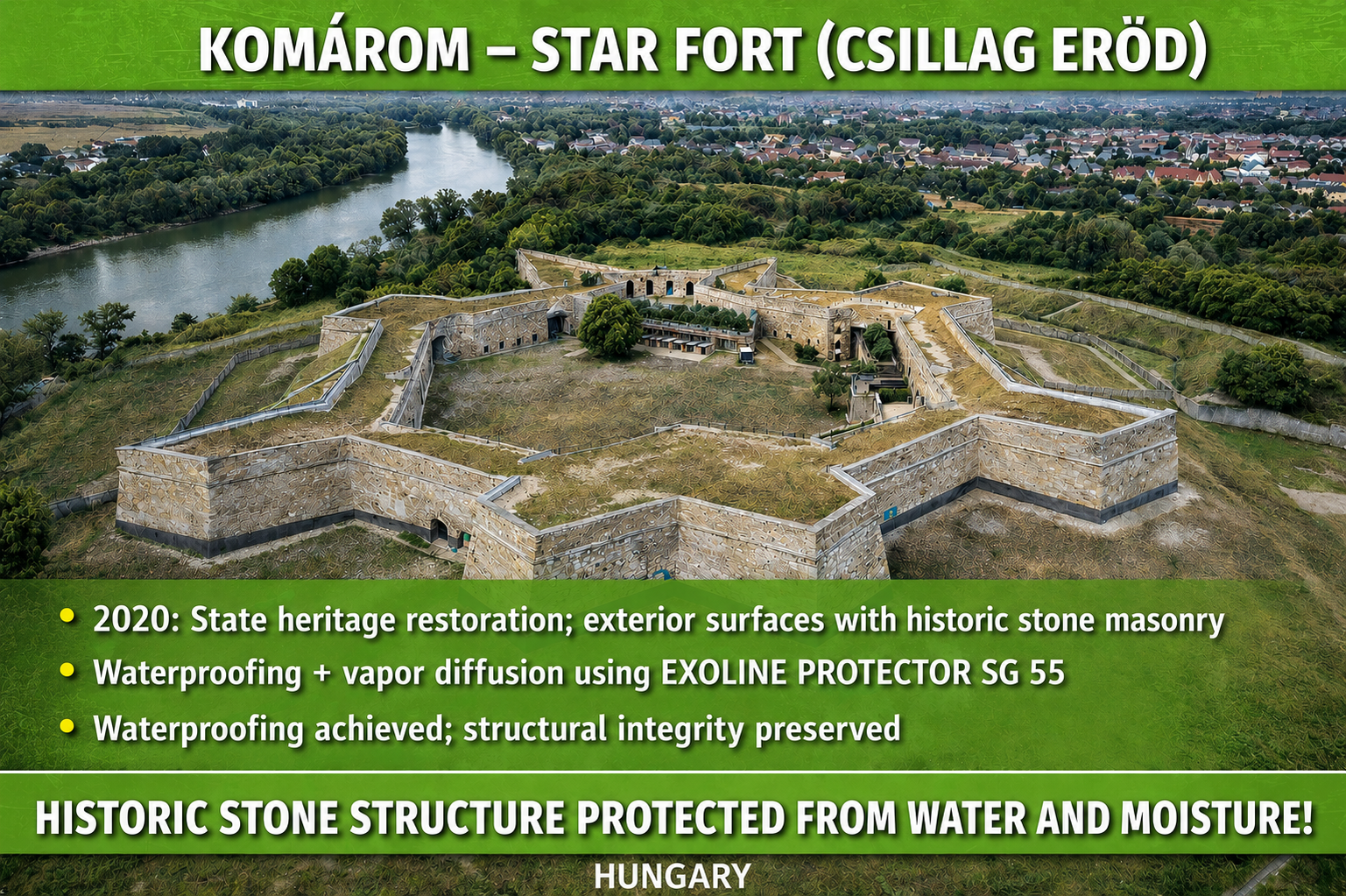
In the critical zones, more than 800 kg of Exoline® PROTECTOR SG-55 concrete additive was subsequently applied to reinforce waterproofing and structural durability. Integrated directly into the concrete matrix, the additive reduced capillary water absorption and significantly increased resistance to continuous water pressure. Following the intervention, the treated sections remained stable and completely free from moisture-induced damage. In contrast, areas without reinforcement continue to show periodic signs of deterioration.
This phase of the project effectively served as a technical rescue operation, enabling the safe completion and operational handover of the facility. The experience highlights a broader industry phenomenon: large international suppliers are often preferred, even in cases where special conditions would call for alternative solutions. Material selection is not always based purely on technical performance criteria - a common challenge across the sector. However, when decisions are driven by targeted engineering performance, long-term structural safety and durability can be significantly improved.
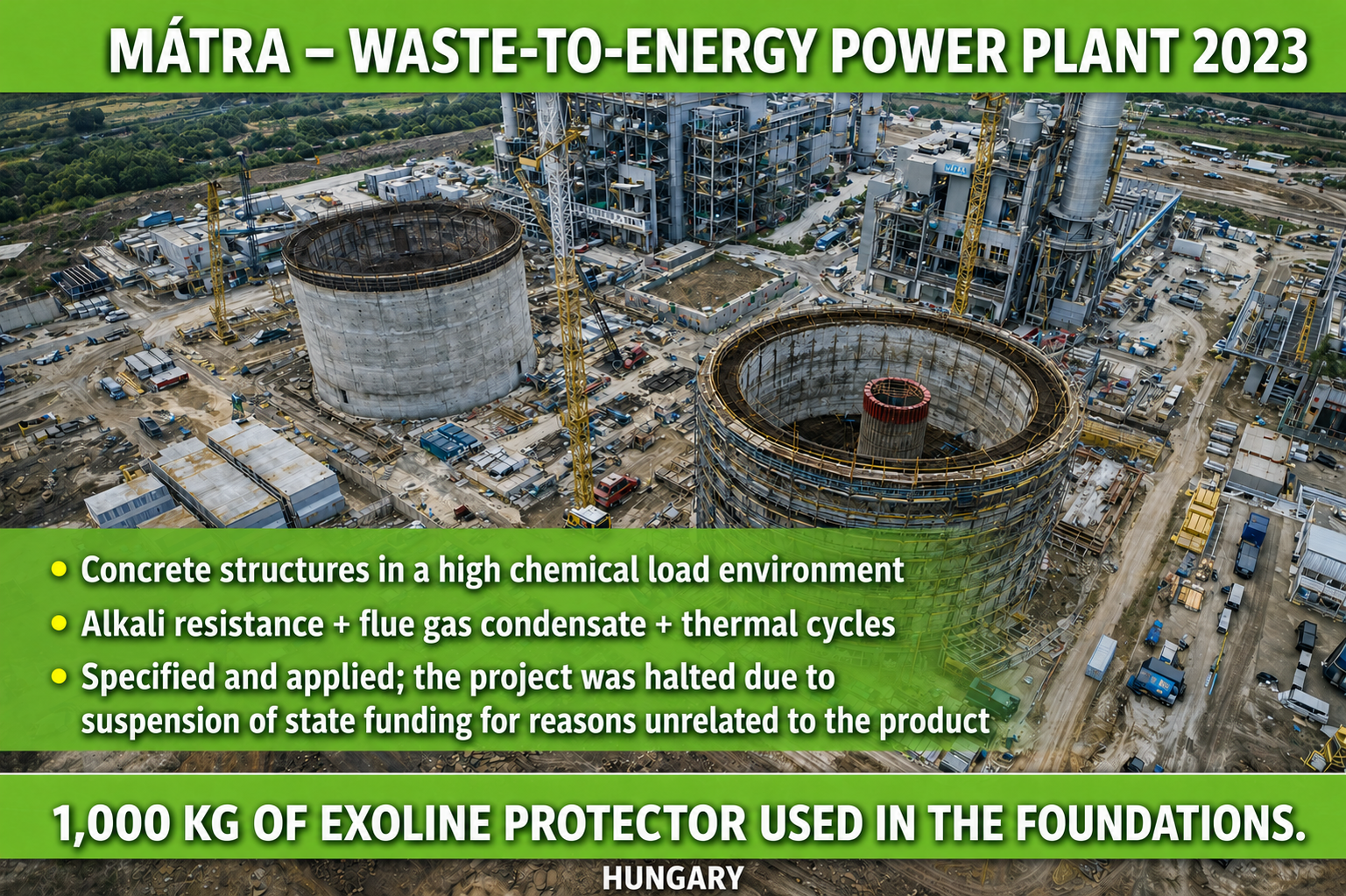
During the construction of the planned waste-to-energy facility in the Matra region, a detailed technical study was prepared to define the structural requirements and the performance criteria of the required specialized concrete admixture. The plant's concrete structures are exposed to extreme conditions, including high thermal loads, acidic flue gas condensate, alkaline environments, and continuous thermal cycling. For this reason, the engineering documentation specified the use of a high-performance concrete admixture capable of providing heat resistance, acid resistance, watertightness, and enhanced structural hardness simultaneously.
Approximately 1,000 kg of Exoline® PROTECTOR concrete admixture was incorporated into the foundations and floor structures, particularly in the base structures of the large chimneys. The admixture densifies the concrete matrix, reduces capillary water absorption, improves chemical resistance, and increases structural stability under heavy load.
If the project resumes, several tons of Exoline® concrete admixture will be required to ensure long-term durability and protection of the entire structural system. Given the nature of the facility, only a high-performance concrete admixture capable of simultaneously resisting thermal, chemical, water, and mechanical stresses can provide lasting structural reliability.